Dietary · 3 min read ·
Vegetarian Food in Vietnam: What to Order, What to Avoid (Đồ Chay Guide)
Vietnam is quietly one of the best countries in Southeast Asia to eat vegetarian — if you know how to navigate it.
The country has a strong Buddhist vegetarian tradition (đồ chay), and dedicated vegetarian restaurants are common. But outside those, "vegetable" dishes are not always what they seem. This guide shows you what to seek out, what to question, and how to filter any menu to vegetarian or vegan in a single tap.
Đồ chay culture: why Vietnam is secretly great for vegetarians
Đồ chay means vegetarian food, and it's deeply rooted in Vietnamese Buddhist culture. On the 1st and 15th of the lunar month, many Vietnamese eat vegetarian, so demand is high and the food is genuinely good — not an afterthought.
You'll find dedicated cơm chay (vegetarian rice) restaurants and phở chay (vegetarian phở) shops in most towns. The variety is impressive: mock meats made from tofu and seitan, fresh vegetables, herbs, and rice and noodle dishes that rival their non-vegetarian counterparts.
The fish-sauce trap (why "vegetable" dishes often aren't)
Here's the catch for vegetarians and vegans: fish sauce (nước mắm). It's the universal seasoning in Vietnamese cooking, and it turns up in dishes that otherwise look plant-based — stir-fried vegetables, salads, broths, and dipping sauces.
A dish labelled "rau xào" (stir-fried vegetables) may well be seasoned with fish sauce or oyster sauce. So "vegetable" on the menu does not automatically mean vegetarian.
The fix is to ask for dishes to be made without fish sauce — or, far easier, to eat somewhere that marks its vegetarian dishes clearly.
Dishes to seek out, dishes to question
Seek out:
- Phở chay — vegetarian noodle soup (confirm the broth).
- Cơm chay — vegetarian rice plates.
- Gỏi cuốn chay — vegetarian fresh spring rolls.
- Đậu hũ — tofu dishes (confirm the sauce).
- Bánh mì chay — vegetarian baguette.
Question:
- Any stir-fry or salad (fish sauce likely).
- Standard phở broth (often meat-based).
- Anything with a savoury sauce you can't identify.
Filtering any menu to vegetarian or vegan instantly
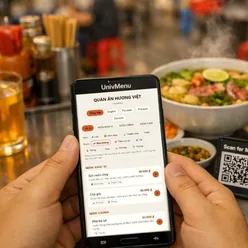
A multilingual QR menu makes this effortless. On a UnivMenu menu, tap the "vegetarian" or "vegan" filter and the menu shows only the dishes that match — in your own language, with prices and descriptions. No more pointing and hoping, no more fish-sauce surprises.
You can stack filters too — for example, vegetarian plus avoid gluten if you have additional needs. And the kitchen gets your order in Vietnamese, so what you order is what arrives.
Try it on a real menu: see a live menu.
For restaurant owners: a vegetarian filter brings in a whole new customer base
Vegetarian and vegan travellers actively seek out restaurants that cater to them — and they're loyal when they find one. If you run a restaurant in Vietnam, clearly marking your đồ chay dishes and making them filterable in a guest's own language is a low-cost way to win a growing market.
A multilingual menu with vegetarian and vegan filters costs less than a coffee a day. see pricing
Traveller? Found a great spot that isn't on the map yet? Create a free multilingual menu for them and earn a recurring finder reward if they activate it. create a free menu mockup
FAQ
Is Vietnamese food vegetarian-friendly?
Surprisingly yes. Vietnam has a strong Buddhist vegetarian tradition (đồ chay), and dedicated vegetarian restaurants are common in most towns. The catch is that outside those, many "vegetable" dishes are seasoned with fish sauce, so you need to ask or eat somewhere that labels dishes clearly.
What does "đồ chay" mean?
Đồ chay means vegetarian food in Vietnamese, rooted in Buddhist cuisine. Restaurants labelled cơm chay serve vegetarian rice meals, and phở chay is vegetarian noodle soup. On the 1st and 15th of the lunar month many Vietnamese eat vegetarian, so the food is genuinely good and widely available.
Is phở vegetarian?
Standard phở is not — the broth is usually meat-based. But phở chay (vegetarian phở) is widely available and uses a vegetable broth. Always confirm, because even some vegetable dishes use fish sauce or oyster sauce for seasoning.
Does Vietnamese food put fish sauce in vegetable dishes?
Frequently, yes. Fish sauce (nước mắm) is the default seasoning, so a stir-fried vegetable dish (rau xào) may well contain it. To eat truly vegetarian, ask for dishes to be made without fish sauce, or choose a dedicated đồ chay restaurant.
Can vegans eat in Vietnam?
Yes. Vegan travellers should look for đồ chay restaurants and confirm dishes contain no fish sauce, oyster sauce, egg, or dairy. A menu with a vegan filter makes this easy — tap the filter and see only the dishes that match, in your own language.
Read this in Vietnamese: Đồ chay ở Việt Nam: ăn chay đúng cách, tránh nước mắm, chọn món chuẩn