Ordering · 5 min read ·
How to Order Food in Vietnam Without Speaking Vietnamese (A Practical Guide)
Eating well in Vietnam is one of the great travel experiences. Ordering it confidently is something else entirely.
The food is extraordinary. The barrier is the menu: a wall of Vietnamese, often with no pictures, no English, and a kitchen that may not speak a word of your language. Most travellers get by with a combination of pointing, guessing, and quietly hoping. It works — until it doesn't, and you end up with a dish you can't eat, or miss the one thing you came to try.
This guide shows you how to actually order food in Vietnam without speaking Vietnamese: the phrases that help, how to read a Vietnamese menu, and the faster way that more travellers are now using.
Why the language barrier is the #1 friction for eating well
Vietnam's best food is often its most local — the family stall, the alleyway phở shop, the regional speciality with no English sign. These are exactly the places with no English menu and no English-speaking staff.
So travellers face a choice: eat at the tourist-facing restaurants (safe, but often blander and pricier), or gamble at the local places where the food is genuinely better. The language barrier is what keeps most people on the safe side — and it costs them the best meals of the trip.
The 5 phrases that get you by (and where they fail)
A little Vietnamese goes a long way, socially. Locals appreciate the effort, and these five will carry you far:
- Xin chào — hello
- Cảm ơn — thank you
- Bao nhiêu tiền? — how much is it?
- Tôi không ăn được… — I can't eat… (follow with the ingredient)
- Tính tiền — the bill, please
The problem is that these phrases get you to the order, not through it. You can ask the price and say thank you, but you still can't read the menu, understand what's in a dish, or explain a serious allergy. Phrases are a bridge to the table — not a substitute for understanding what you're ordering.
How to read a Vietnamese menu: the anatomy of a dish
Vietnamese dish names are descriptive once you know the pattern. Most follow a structure: cooking method + main ingredient + (region or style).
A few building blocks to recognise:
- Phở — rice noodle soup · Bún — rice vermicelli · Cơm — rice · Bánh mì — baguette sandwich
- Bò — beef · Gà — chicken · Heo / Lợn — pork · Tôm — shrimp · Cá — fish
- Xào — stir-fried · Nướng — grilled · Chiên — fried · Hấp — steamed · Kho — braised
So bún bò xào is vermicelli + beef + stir-fried. Cơm gà nướng is rice + chicken + grilled. Once you can spot the protein and the method, you can decode a surprising amount — but you'll still miss sauces, hidden ingredients, and the subtle regional differences that matter.
Pointing, guessing, and the real cost of ordering blind
Pointing at what the table next to you is eating is a time-honoured tactic. It works for the obvious dishes. It fails when:
- You have an allergy and can't see what's in the dish.
- The dish has a name but no picture.
- You're vegetarian and can't tell which dishes use fish sauce or meat stock.
- You want to order several dishes and the staff are busy.
The cost isn't just an occasional wrong order. It's the meals you never try because you couldn't work out what they were.
The allergy and dietary problem (the part pointing can't solve)
If you have a food allergy, pointing is not a strategy. Vietnamese cooking uses peanut, shellfish, and fish sauce pervasively, and cross-contact in a busy wok kitchen is common. Explaining "I have a severe peanut allergy" in Vietnamese is beyond most travellers — and getting it wrong is genuinely dangerous.
We cover this in depth in our Vietnam Food Allergy Guide, including a printable allergy card you can show staff.
A faster way: scan, read in your language, order
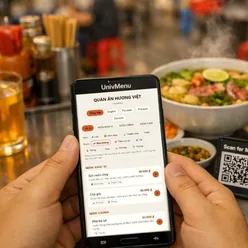
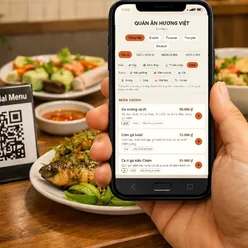
More restaurants in Vietnam are now solving this with a multilingual QR menu. You scan a QR code at the table with your phone, and the full menu opens in your own language — English, Russian, French, German, Spanish, or Chinese in either Simplified or Traditional — with prices, spice levels, and dietary marks exactly as printed.
The best part: you can filter the menu. Tap "vegetarian" or "no pork" and the menu reshapes to show only what you can eat. Tap "peanut" under "avoid" and every dish containing peanut disappears. You build your order on your phone, and the kitchen receives it in Vietnamese — so there's no miscommunication on their side either.
No app to download. No account to create. It works even if your signal is weak.
You can see exactly how this looks on a real restaurant menu here: see a live menu.
How travellers are earning by helping restaurants go multilingual
Here's a twist: if you love eating at local spots, you can help the next restaurant you visit go multilingual — and earn from it.
UnivMenu lets anyone create a free menu mockup for a restaurant in minutes. If the owner activates it, you are that restaurant's finder — and the finder reward is 40% of what they pay for the first 6 months, then 20% for as long as they keep paying. It's a genuinely useful way to fund a longer trip while helping local businesses welcome travellers like you.
FAQ
Do you need to speak Vietnamese to order food in Vietnam?
No. In tourist areas many restaurants have English menus or staff, and a few polite Vietnamese phrases go a long way. At local stalls with no English, the easiest approach is a multilingual QR menu: you scan it, read every dish in your own language, and order without speaking Vietnamese at all.
How do I read a Vietnamese menu?
Vietnamese dish names follow a pattern: cooking method + main ingredient + style. Recognise a few building blocks — phở (noodle soup), bún (vermicelli), cơm (rice), bò (beef), gà (chicken), heo (pork), xào (stir-fried), nướng (grilled) — and you can decode a lot. A translated digital menu removes the guesswork entirely.
Is it safe to eat street food in Vietnam?
Generally yes, and it's often the best food you'll have. Choose busy stalls with high turnover, watch it cooked fresh, and avoid raw herbs you can't verify are washed. If you have an allergy, street food needs extra care — see our Vietnam food allergy guide.
How do I order food in Vietnam if I have allergies?
Learn the ingredient word, carry a written allergy card in Vietnamese, and confirm with staff before ordering. Assume cross-contact is possible in a shared wok kitchen. A menu with allergen filters helps you avoid risky dishes before you even speak to staff.
What is the easiest way to order food in Vietnam without Vietnamese?
Scan a multilingual QR menu. It opens in your language, lets you filter by diet or allergy, and sends your order to the kitchen in Vietnamese — so there's no miscommunication. No app, no account, and it works even with a weak signal.
Read this in Vietnamese: Đặt món nhanh ở quán ăn đông khách, đúng khẩu vị — không cần chờ nhân viên