Dietary · 3 min read ·
Is Vietnamese Food Halal? An Honest Guide for Muslim Travellers
The honest answer: most Vietnamese food is not halal by default — but eating well as a Muslim traveller in Vietnam is absolutely possible if you know what to look for.
Vietnamese cuisine is pork-heavy, and even dishes that look meat-free often carry hidden non-halal ingredients. This guide gives you the straight picture: why it's tricky, which dishes are naturally halal-friendly, how to spot the hidden problems, and the easiest way to filter a whole menu to halal-only.
The short answer: mostly not — and here's why
Two ingredients make standard Vietnamese food difficult for halal diners:
- Pork (heo / lợn). It's the most common meat, and it appears everywhere — grilled, in broths, as pâté in bánh mì, and in sausage (chả lụa).
- Alcohol and non-halal slaughter. Some dishes use rice wine, and meat in non-certified restaurants is not slaughtered to halal requirements.
Beyond that, many kitchens are not separated — pork and other meats are prepared on the same surfaces and in the same oil.
The dishes that are naturally halal-friendly
Vietnam has a Muslim community (notably the Cham people), and halal restaurants do exist in larger cities. Outside those, look for dishes that are plant- or seafood-based and can be confirmed as pork-free:
- Fresh spring rolls (gỏi cuốn) — request without pork; the shrimp version is common.
- Seafood dishes — grilled fish, prawns, squid (confirm no pork or alcohol in the marinade).
- Rice and noodle dishes with vegetables — confirm the stock and sauce.
- Fruit and chè (sweet dessert soups) — usually safe.
Always confirm the stock and sauces, which is where pork and alcohol hide.
How to spot the hidden non-halal ingredients
The tricky ones are invisible:
- Pork stock in phở and other broths (some use beef, some mix).
- Fish sauce (nước mắm) — halal in itself for most scholars, but worth confirming.
- Pork fat / lard used for frying in some kitchens.
- Rice wine in marinades.
The reliable approach is to ask directly, or — much easier — to eat somewhere that already labels dishes clearly.
Filtering a whole menu to halal-only in one tap
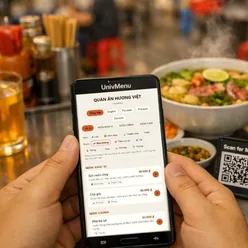
This is where a multilingual QR menu changes the experience. On a UnivMenu menu, you can tap the "halal" filter and the menu instantly shows only halal-marked dishes — in your own language. No guessing, no pointing, no language barrier with the kitchen.
You can also combine it: filter to halal and avoid pork at the same time for extra certainty. And because the kitchen receives your order in Vietnamese, there's no miscommunication about what you've ordered.
See how it works on a real menu: see a live menu.
A note for restaurant owners: how to welcome Muslim guests
If you run a restaurant in Vietnam, halal-conscious travellers are a large, loyal, and underserved market. Clearly marking your halal-friendly dishes — and making them easy to find in a guest's own language — is one of the highest-value things you can do for your business.
A multilingual menu with a halal filter does exactly this, for less than the price of a coffee a day. see pricing
And if you're a traveller who finds a great restaurant that could welcome more Muslim guests, you can create a free multilingual menu for them and earn a recurring finder reward if they sign up. create a free menu mockup
FAQ
Is Vietnamese food halal?
Most traditional Vietnamese food is not halal by default, because pork is the most common meat and some dishes use rice wine. However, halal-friendly options exist — especially seafood, plant-based dishes, and dedicated halal restaurants in larger cities. Always confirm the ingredients and preparation.
Is phở halal?
Usually not automatically. Phở broth can be made from beef, pork, or a mix, and the meat is not necessarily halal-slaughtered. Look for a dedicated halal phở restaurant, or confirm the broth base and meat source before ordering.
Are there halal restaurants in Vietnam?
Yes. Vietnam has a Muslim community (notably the Cham people), and halal restaurants operate in Ho Chi Minh City, Hanoi, and other major areas. Outside those, your safest bets are seafood and vegetable dishes you've confirmed contain no pork or alcohol.
Does Vietnamese food contain pork?
Very often. Pork is the most widely eaten meat and appears grilled, in broths, as pâté in bánh mì, and in sausage (chả lụa). It can also be present invisibly in stocks and lard used for frying, so confirmation matters.
Is fish sauce halal?
For most Islamic scholars, plain fish sauce (nước mắm) is considered halal, since it's made from fish and salt. Opinions can vary, so if you follow a specific school of thought, confirm with a trusted authority. The bigger halal concerns in Vietnam are pork and alcohol.
Read this in Vietnamese: Ăn halal ở Việt Nam: hướng dẫn thực tế cho cộng đồng người Hồi giáo