For owners · 4 min read ·
Why Your Restaurant Needs a Multilingual QR Menu — and How to Get One Free
You opened a restaurant in Vietnam because the food is incredible and the market is alive. Then you discovered the catch: a huge slice of your potential customers — tourists and expats — walk past, or walk in and order the same three "safe" dishes, because they can't read your menu.
If you run a restaurant in Vietnam and your menu is Vietnamese-only, you are leaving money on the table every single day. Here's why, and how to fix it for less than the price of a coffee a day.
The tourists (and locals) you're losing right now
Vietnam welcomed millions of international visitors last year, and they want to eat local. But faced with a Vietnamese-only menu and no English-speaking staff, most travellers default to what they can identify — or leave.
It's not just tourists, either. Expats living in Vietnam, and Vietnamese diners with dietary needs, are all easier to serve when your menu is clear, visual, and filterable. Every guest who can't read your menu is a guest who orders less, or doesn't order at all.
Why a PDF or Google Translate isn't enough
You might think a translated PDF or pointing guests to Google Translate solves it. It doesn't:
- A PDF menu is static — no filtering, no photos, hard to read on a phone, and a pain to update.
- Google Translate is slow and unreliable on dish names, and it can't tell a guest which dishes are vegetarian, halal, or peanut-free.
- Neither reaches your kitchen. Even if a guest translates a dish, the order still has to be communicated to your Vietnamese-speaking staff — where the misunderstanding usually happens.
What you need isn't a translation. It's an ordering layer that speaks to the guest in their language and to your kitchen in Vietnamese.
What a multilingual QR menu actually does
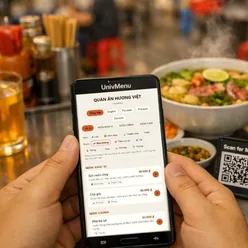
A multilingual QR menu turns your printed menu into a live site that guests access by scanning a QR code at the table — no app, no account.
- Eight languages. Your menu appears in Vietnamese plus English, Russian, French, German, Spanish, and Chinese in both Simplified and Traditional — covering the biggest visitor groups.
- Dietary and allergy filters. Guests tap "vegetarian," "halal," "no pork," or "avoid peanut" and the menu reshapes to show only what they can eat. This is the feature that turns hesitant guests into confident orders.
- Photos and clear descriptions. Add photos and short descriptions so guests know exactly what they're getting.
- Your kitchen still sees Vietnamese. This is the part owners love: the guest orders in their language, but the order reaches your kitchen in Vietnamese. Your staff never have to read a translation. No miscommunication, no slowdown.
You can see a live example here: see a live menu.
"But my kitchen only speaks Vietnamese" — solved
This is the most common objection, and it's already handled. The whole point of the system is that the translation is for the guest, not the kitchen. Your cooks see dish names in Vietnamese, exactly as they always have. The language barrier disappears for the customer without changing anything for your team.
That's the difference between a translation tool and an ordering layer.
How much it costs
Pricing is by menu size (number of dishes), not by seats or locations, and it's rented by the day so it stays affordable:
- Starter (≤50 dishes), Growth (51–120), Scale (121–200), Enterprise (201+).
- In Vietnam, that works out to roughly 9,700₫ a day for the Starter tier — less than a cà phê sữa đá.
- Start before 30 September 2026 and your menu is free until that date; every menu also gets 14 free days of its own, counted from the day it starts, and if yours run past 30 September we let them finish. Either way, no card is required and every add-on is unlocked for the whole of it.
Selling one extra dish a day to a foreign customer covers the cost many times over. see full pricing
Get a free mockup of YOUR menu in minutes
You don't have to take our word for it. Send us a photo of your menu and we'll build a free, high-fidelity mockup of your multilingual site — so you can see exactly what your guests would see, in minutes.
No card. No signup. Every add-on unlocked for the whole free period.
FAQ
What is a multilingual QR menu?
It's a digital menu guests access by scanning a QR code at the table. Your printed menu becomes a live site in eight languages — Vietnamese plus English, Russian, French, German, Spanish, and Chinese in both Simplified and Traditional — with prices, spice levels, and dietary marks. Guests read in their language; your kitchen still sees Vietnamese.
How much does a digital menu cost in Vietnam?
UnivMenu is rented by the day and priced by menu size, not by seats or locations. The Starter tier (up to 50 dishes) works out to roughly 9,700₫ a day in Vietnam — less than a coffee. Start before 30 September 2026 and your menu is free until that date; every menu also gets 14 free days of its own, counted from the day it starts, and if yours run past 30 September we let them finish. Either way, no card is required and every add-on is unlocked for the whole of it.
Do my kitchen staff need to speak English?
No. This is the part owners value most: the translation is for the guest, not the kitchen. Your cooks see dish names in Vietnamese, exactly as they always have. The language barrier disappears for the customer without changing anything for your team.
Do customers need to download an app?
No. Guests scan the QR code and the menu opens in their phone's browser — no app, no account, no sign-up. It even works offline once loaded, which matters for travellers without local data.
How long does it take to set up a multilingual menu?
Minutes. Send a photo of your menu and a high-fidelity mockup of your multilingual site is generated for you to review. You can see exactly what your guests will see before you commit to anything.